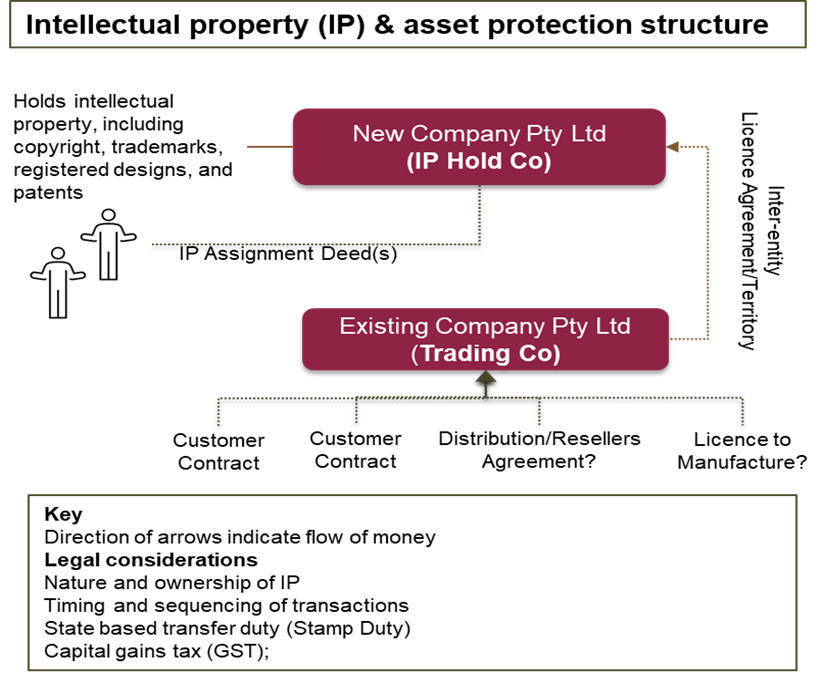
Dundas Lawyers is often asked to advise on and implement intellectual property (IP) protection structures. Whilst there are too many permutations to discuss, one common structure is depicted as follows:
Benefits of an IP protection structure
The most common benefit is to protect valuable IP against the trading risks of an existing or new trading company. In addition, depending on the nature of the IP itself, it may be possible to enter into territory specific licences that will provide revenue to an IP Holding Company to fund continued product development of a product.
In the case of Australian Competition and Consumer Commission v TPG Internet Pty Ltd [2013] HCA 54 (ACCC v TPG), the High Court of Australia (High Court) drew a distinction between mere puffery and representations with the intention of marketing. This article explores the decision in ACCC v TPG and the distinction between puffery and misleading and deceptive conduct. What is puffery? From a legal perspective, specifically contract law, puffery…
This is an update to the article “Full Court clarifies confidentiality of supplier and contact info” published by Dundas Lawyers on 24 February 2026. On 20 April 2026, the Full Court of the Federal Court of Australia (Court) allowed an appeal in the case of New Aim Pty Ltd v Leung (No 4) [2026] FCAFC 49 (New Aim v Leung) which involved alleged breaches of confidential information arising from a…
The case of Lamont v Malishus & Ors (No 4) [2019] FCCA 3206 (Lamont v Malishus) involved an action for infringement of a registered trade mark in Australia under the Trade Marks Act 1995 (Cth) (TMA). This case raised several issues, including, whether using a word as part of a domain name constituted “use” as a trade mark, whether the domain name was identical or deceptively similar to the trade…
The case of International Hair Cosmetics Group Pty Ltd v International Hair Cosmetics Limited [2011] FCA 339 (Case) considered whether use of Australian registered trade marks on a British website constituted “use in Australia” under section 120 of the Trade Marks Act 1995 (Cth) (TMA). It was ultimately held that, despite use of the two (2) trade marks on a British website, where the Respondents registered trade marks in various…
On 11 March 2026, the High Court of Australia (High Court) delivered its judgment in the case of Taylor v Killer Queen, LLC [2026] HCA 5 (Taylor v Killer Queen), ending the seventeen (17) year trade mark dispute between pop star Katy Perry and Australian fashion designer Katie Jane Taylor. In a 3:2 majority decision, the High Court held that the designer’s “Katie Perry” word mark could remain on the…
Further information
If you are considering an IP protection structure regardless of your stage of the business lifecycle, feel free to reach out to discuss your specific requirements:
Malcolm Burrows B.Bus.,MBA.,LL.B.,LL.M.,MQLS. Legal Practice Director T: +61 7 3221 0013 (preferred) M: +61 419 726 535 E: mburrows@dundaslawyers.com.au
Disclaimer
This article contains general commentary only. You should not rely on the commentary as legal advice. Specific legal advice should be obtained to ascertain how the law applies to your particular circumstances.