

Artificial Intelligence (AI) has created opportunities for a quantum leap forward. It’s a shame that the same can’t be said for AI-generated legal contracts (AI Contracts). Dundas Lawyers has noticed an increase in the number of AI Contracts that our clients have been presented with from the ‘other side’ purporting to have been prepared by their ‘lawyer’. These AI Contracts can look the part and even evade detection on initial examination. However, when looked at in detail by a trained eye, they quickly disintegrate. This article discusses the characteristics of Properly Drawn Contract (Properly Drawn Contract) and the hidden cost of attempting to edit or fix AI Contracts.
Characteristics of a Properly Drawn Contract
A Properly Drawn Contract usually has the following characteristics:
- it uses capitalised terms which are defined either in a ‘definitions section’ at the front or back of the document or consistently throughout the body of the document (Defined Terms);
- terms which are defined cannot be used to define themselves (Circular Definitions);
- they use a document style palette with headings and paragraph numbering and automatic cross references (Style Palette);
- they use formatting rules consistently throughout the document (Consistent Formatting);
- they contain boilerplate clauses which are designed to give legal efficacy to the agreement considering its type (Proper Boilerplate Clauses);
- the formatting, numbering and overall language of the document is a window to its original author (Authorship).
- they contain the correct execution clauses considering the legal status of the parties (Execution Clauses).
Defined Terms
A Properly Drawn Contract (depending on its subject matter that is not in a prescribed form such as a sale contract for real property or a standard for telecommunication agreement) can define terms either in a “definitions section” at the front or end, or in the body of the document, but not both. There are always exemptions to this, such as where a paragraph is wholly self-contained.
AI-Contacts may contain a definitions section but then use the definitions consistently throughout the document. Another sign of an AI-Contract (or a contract which was not recently reviewed by a lawyer) is the inclusion of a randomly capitalised phrase that is not defined.
Circular Defintions
Consider the following simple definition:
“Agreement means the terms and conditions contained in this Agreement“.
A term cannot be used to define itself. While this is a small technical point, it shows that the contract you are looking at was not likely prepared by a lawyer. Defined terms should be done so concisely and modified in the context of the paragraph they are not used in the definition itself.
Style Palette
A Properly Drawn Contract will, depending on its length, include a customised ‘Style Palette’ like the examples shown below:
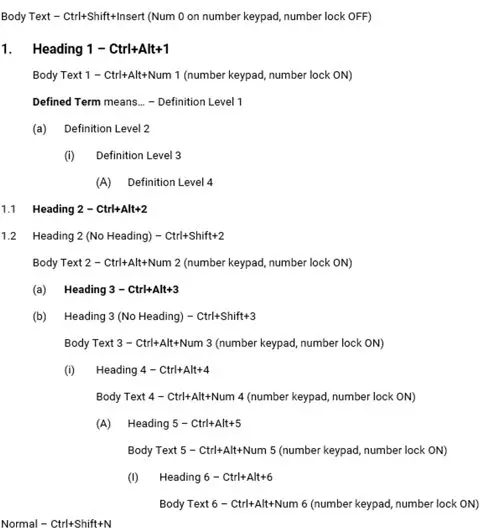
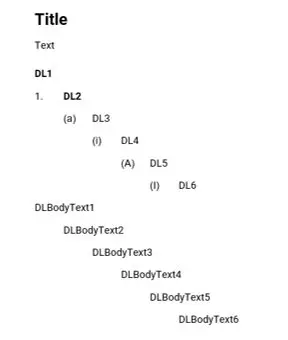
Most law firms of note firms have invested significant amounts of resources ensuring that their contracts appear uniform by adopting their own styles which can sometimes be seen by their name when opening the styles view in MS Word.
Why is a Style Palette important
In a longer Properly Drawn Contract the Style Palette is used to:
- categorise information which appears in a table of contents by the heading 1, heading 2 and so on from the body of document;
- allow for cross references to other paragraphs to be updated automatically if a paragraph is deleted;
- change the look of the entire document by amending the content of the styles it contains
A Properly Drawn Contract allows for an author to delete a paragraph in mark-up (redline), with all affected cross-references throughout the document being automatically updated. Conversely if the cross references are ‘hard coded or manually added‘ it can take a lot more time to edit or amend the document in question than it should.
Consistent Formatting
There is nothing worse than looking at the paragraphs in the body of a contract noting that certain paragraphs of text are 1 line spacing and the next is 1.5 or 2 or worse yet use of slightly different fonts between paragraphs! It shows a lack of attention to detail and lack of understanding of how to use the tools of the trade (MS Word). Moreover, it could be another indicator that the document presented is not a Property Drawn Contract.
In some cases, a trained eye can tell quickly if a contract is outdated; for example, where it refers to legislation by an obsolete or repealed title, such as the Trade Practices Act 1974 (Cth) instead of the Competition and Consumer[MB1] Act 2010 (Cth). Worse yet is where a contract is obviously based on a precedent that has not been properly adapted because it incorrectly references legislation from other countries or jurisdictions!
Proper Boilerplate Clauses
What is a boilerplate clause?
Boilerplate clauses are generally defined as those which are required to give legal efficacy to its terms. For example, ‘entire agreement’, ‘waiver’ and ‘approvals and consents’ are examples of boilerplate clauses. Of course, as each contract is different so are the boilerplate clauses that you would expect to see. For example, the boilerplate clauses that you would expect to see in a Self-Managed Superannuation Fund Deed are likely to be very different to those in a Deed of Release in a litigious matter.
AI Contacts can cobble together a range of boilerplate clauses (sometimes from different jurisdictions), some of which are relevant and some of which can be nonsensical. On occasion we see contracts that should contain boilerplate clauses that don’t or in some cases clauses which clearly only apply to other contact types. In either case it’s a clear indication that the document is not a Properly Drawn Contract.
Authorship
In a lot of cases, it can be relatively easy to determine the providence of a contract depending on how it is laid out and architected. The language used and the formatting are clues which are easily used to determine if you are dealing with a Properly Drawn Contact or not. Another clue can be found when opening the Style Palette in MS word. If the author has their own style palette and they cut and paste a clause into the document they often incorporate their document styles into the document. So it can be easy to see if multiple lawyers have been editing the contract you have been presented with.
Execution Clauses
The Corporations Act 2001(Cth) has rules for contracts signed by directors of companies and there are other rules that apply where the document is to be signed by a corporate trustee or by a partnership. For example, Properly Drawn Contracts have included both the correct execution clauses and they are complete. For lawyers its these simple things that must be complete in all respects. AI Contracts often include signed by #insert name# as opposed to the actual party information.
Benefits of Properly Drawn Contracts
Documents that are not Properly Drawn Contracts often take significantly more time to fix than it would take to draft them from scratch. Recently we have been presented with a number of contracts to review which are purportedly prepared by a lawyer and asked to make any changes we consider to be appropriate. Where you have been provided with a contract that was supposedly from the “other sides lawyer” and its clearly not, the first step in a business relationship based on a lie is not a good start. Why should you have to pay to edit a contract which is either an old ‘do it yourself job’, or an AI-Contract that needs significant work.
Conversely when we receive a Properly Drawn Contract to review it saves a lot of time and they can be a joy to amend. This is because they are usually correct in all respects, albeit biased towards the author’s client.
Further information
If you need advice on the application of Director IDs, or director’s duties more broadly, contact us for a confidential and obligation‑free discussion.

Malcolm Burrows B.Bus.,MBA.,LL.B.,LL.M.,MQLS.
Legal Practice Director
T: +61 7 3221 0013 (preferred)
M: +61 419 726 535
E: mburrows@dundaslawyers.com.au
Disclaimer
This article contains general commentary only. You should not rely on the commentary as legal advice. Specific legal advice should be obtained to ascertain how the law applies to your particular circumstances
