
——— Litigation and disputes · Brisbane
Unfair competition lawyers Brisbane
Dundas Lawyers® identifies and collates admissible evidence of an aggressive competitor's conduct, for the purpose of pursuing or exposing the competitor.
📞
Direct Line – Brisbane
Reviewed by Malcolm Burrows, Legal Practice Director · Last updated 10 November 2026
——— Quick summary
Quick summary of unfair competition
Unfair competition is conduct by an aggressive competitor that crosses the line between fair competition and conduct that is reportable to a regulator or legally actionable. Provisions similar to those of the old Trade Practices Act are now contained in the Australian Consumer Law. Dundas Lawyers® carries out ILACC reviews of competitor conduct, from Brisbane.
On this page
- What is unfair competition?
- How can our unfair competition lawyers help?
- What does the law say about unfair competition?
- How does the unfair competition review process work?
- Common unfair competition issues
- Practical tips about unfair competition
- Key takeaways about unfair competition
- Why choose Dundas Lawyers for unfair competition?
- Examples and case law about unfair competition
- Frequently asked questions about unfair competition
- Legislation for unfair competition
- Need a lawyer in Brisbane to advise on unfair competition?
- Recent insights about unfair competition
- Recent Federal Court decisions about unfair competition
——— Definition
What is unfair competition?
Unfair competition is conduct by an aggressive competitor that seems to be cutting corners in gaining market share and may cross the line between fair and being reportable or legally actionable.
Years ago, the notion of unfair business competition was associated with the provisions of Trade Practices Act 1975 (Cth). Nowadays similar provisions are contained in Schedule 2 to the Australian Consumer Act 2010 (Cth) (Australian Consumer Law) and generally thought to be associated with concepts such as price fixing, cartel conduct, exclusive dealings, retail price maintenance, third line forcing, anti-competitive mergers or other abuses of market power.
Whilst these concepts apply to the conduct of larger business, they are usually of little use to medium sized businesses that find themselves "under attack" by aggressive competitors. In some cases, the actions of the competitor are overly aggressive, and they seem to be cutting corners in gaining market share. If you can't seem to put your finger on what's wrong with the actions of the competitor but know something doesn't seem right or if you need a law firm with Uncommon Nous® to identify and collate admissible evidence for the purpose of pursuing or exposing the competitor then you need ILACC. Information is power!
Unfair competition review is part of our litigation and disputes practice. See also our competition law and forensic legal investigations pages. This commonly involves:
- false and misleading statements about a competitor's goods or services;
- misleading and deceptive conduct;
- regulatory non-compliance;
- trademark infringement and domain name disputes; and
- negative SEO and fake Google reviews.
——— Our services
How can our unfair competition lawyers help?
An ILACC review is a unique service by Dundas Lawyers® used to identify actions of a competitor to determine whether they "cross the line".
Does your business need an unfair competition review?
Identify Legally Actionable Competitor Conduct (ILACC)
- Legally Actionable or Reportable
- Shield
- Regulatory non-compliance
- Legally actionable
- Competition law
- False and misleading statements section 29(1)
- Misleading and deceptive conduct section 29
- Trademark infringement
- Domain name disputes
The aim of ILACC is to identify actions of the competitor that are 'reportable' and/or 'legally actionable'. Generally, unless thousands of businesses or individuals are significantly affected attempts to report unfair competition to the likes of the Australian Competition and Consumer Commission (ACCC) or the Australian Securities and Investments Commission (ASIC) fall on deaf ears. That said depending on the circumstances, there is certain conduct that can be reported and be actioned by the applicable regulator. We refer to this as being reportable conduct (Reportable). An ILACC review is a unique service by Dundas Lawyers® used to identify actions of a competitor to determine whether they "cross the line" between fair and being Reportable or legally actionable (Actionable).
What's involved in an ILACC review?
An ILACC review aims to identify, document and preserve admissible evidence on the activities of a competitor and their related parties that may be Reportable or Actionable. In some cases, where the competitor is crossing the line may be obvious. In others it's not clear and it becomes necessary to identify, collate and preserve admissible evidence for use in future legal proceedings.
What happens after an ILACC review is completed?
There is no guarantee (of course) that an ILACC review will identify a legal cause of action against the competitor. However, it may identify gaps in a business's defences that need to be addressed to protect its future growth.
Knowledge is power
If in the alternative an ILACC review identifies unfair competitive conduct, then the documented admissible evidence is collated and preserved for later use in considering a legal remedy. A particular focus of the ILACC review is identifying any individual that can be held to be personally liable for the competitor's conduct. We then provide options to seek a legal remedy against the competitor and to hold the individuals behind it accountable.
——— The law
What does the law say about unfair competition?
Competitor conduct can be reportable or legally actionable under the Australian Consumer Law, including false and misleading statements and misleading and deceptive conduct.
This includes:
False and misleading statements
Unrealistic statements used to promote goods and services can be 'false and misleading' in breach of section 29(1)(a) to (n) of Schedule 2 of the Australian Consumer Law.
Misleading and deceptive conduct
Unrealistic statements used to promote goods and services can amount to misleading and deceptive conduct in breach of section 18.
Regulatory non-compliance
The legislative environment that the competitor operates in, the permits, approvals or certifications that are required are also reviewed. Any non-compliance could be actionable or reportable.
Intellectual property
On some occasions unfair competition manifests itself in the form of applications for registration of intellectual property rights that attempt to circumvent those of others.
——— Process
How does the unfair competition review process work?
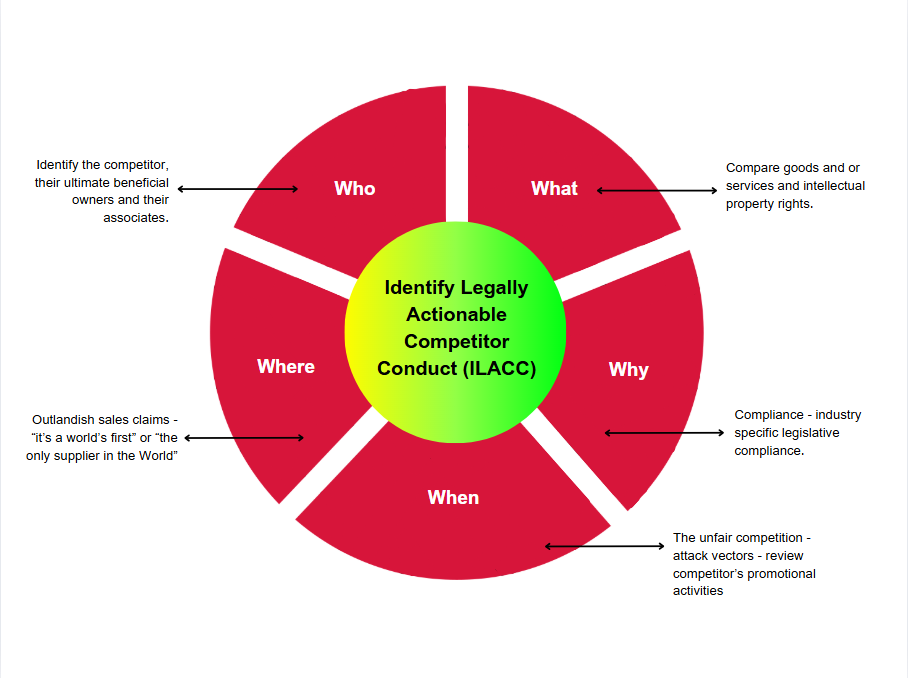
An ILACC review works through five (5) steps: who, what, why, where and when.
Who? Identify the competitor, their ultimate beneficial owners and their associates
Sometimes those behind the competitor may be unknown, if this is the case the first step is to identify the ultimate beneficial owners of the competitor. It's critical in order to respond to unfair competition to have the required information at your fingertips. This involves, particularising and documenting:
- the competitor's trading name, company name, the director(s), the ultimate beneficial owners, and their addresses (Corporate Information);
- all related entities of the competitor;
- all social media channels being used by the competitor;
- all registered trademarks being used by the competitor or its related companies;
- all domain names registered in the competitor's name or those of its directors; and
- all websites that the competitor promotes its goods or services on (Promotional Channels).
Insiders – It's uncommon (however it does happen) that the competitor is obtaining and exploiting information from one or more employees or director for the sole purpose of competing unfairly. If this is suspected, we work with a variety of leading private investigators to identify and collate admissible evidence of the activities of any insiders. See our article on preventing data loss from internal threats.
What? Compare goods and or services and intellectual property rights
After the competitor's Corporate Information and Promotional Channels have been particularised, a comparison with the competitor's goods and or services is undertaken. On some occasions unfair competition manifests itself in the form of applications for registration of intellectual property rights that attempt to circumvent those of others. Depending on the competitor and those that are behind it, this involves a review of:
- trademarks;
- domain name registrations;
- patents;
- passing off; and
- other relevant intellectual property.
Why? Compliance – industry specific legislative compliance
Because each business is different so is the legislation and regulations that govern its operation. For example, if your business manufactures therapeutic goods then there is specific legislation that must be complied with when advertising. If a competitor says that it is 'Certified Organic showing a particular registration number' then it is subject to the certification rules of the particular organic certifier. The legislative environment that the competitor operates in, the permits, approvals or certifications that are required are also reviewed. Any non-compliance could be actionable or reportable.
Where? Outlandish sales claims – "it's a world's first" or "the only supplier in the world"
If it looks like a duck and quacks like one – it's a duck. If the competitor is making statements about its goods or services that seem unrealistic then it's worth confirming whether they are in fact true or not. Unrealistic statements used to promote goods and services can be 'false and misleading' in breach of section 29(1)(a) to (n) of Schedule 2 of the Australian Consumer Law (ACL) and amount to misleading and deceptive conduct in breach of section 18. The line between sales puffery and false and misleading statements can be quite blurred. Read about false and misleading statements here.
See the case involving false and misleading statements and misleading and deceptive conduct, Native Extracts Pty Ltd v Plant Extracts Pty Ltd [2023] FCA 1265, where Dundas Lawyers acted for the applicants and obtained numerous orders for corrective advertising.
When? The unfair competition – attack vectors – review competitor's promotional activities
The way that the competitor promotes itself can readily be seen by their actions online. The rise of anonymity and social media has had the effect of pouring petrol on a fire for those involved in sharp practice and unfair competition.
Trap purchase from the competitor – Depending on the circumstances a purchase of the goods or services from the competitor (Trap Purchase) may assist to identify information about the competitor's goods and services that could provide evidence that is legally actionable. Trap Purchases are usual in any sort of intellectual property infringement matter to provide evidence of sales of particular goods or services.
——— Common issues
Common unfair competition issues
The way that the competitor promotes itself can readily be seen by their actions online.
01
Review of all websites
The websites that the competitor uses to promote its goods and services can be fertile ground for unfair competition and online passing off activities. This is because many of the tags used to index a webpage by Google are hidden and not visible to the browser of the page. It can therefore be easy to mimic what your company has done to gain market share quickly.
02
Meta tags
Whilst not definitive or (generally legally actionable) an analysis of the competitor's meta keywords may provide an indication if they have copied those of others and what they are doing to promote their goods or services.
03
Domain names registrations
Competitors registering domain names that are closely associated with yours that they have no right to register is also considered and documented.
04
Google Adwords
We maintain subscriptions to software that allows us to show the words that are being used by the competitor in Google adwords to attract customers. It is rare but possible that the competitor is using Google adwords in a way that is illegal or reportable.
05
Negative SEO
One of the most vile things that a competitor can do is to engage in anonymous negative SEO (Negative SEO). We have noticed the phenomenon of competitors (or unknown actors) somehow arranging for their opposition to be added to link farms that are perceived by Google to be toxic, with the result being an attenuation in your business's search engine rankings. Those engaged in Negative SEO are cowards, hiding anonymously behind VPNs and the likes of Cloudflare.
What is a toxic backlink? According to SEM Rush:
"Toxic backlinks (or bad backlinks) are incoming links that negatively affect your website's visibility in search engine results pages or have the potential to. The term usually refers to links that violate Google's link spam guidelines because they were placed on external sites for SEO purposes, rather than for users' benefit".
Negative SEO is a thing and can on review be easily detected and defended.
06
Fake Google reviews
Another cowardly attack is for a competitor to create fake Google Reviews that Google refuses to take down without a Court order. The fact that Google allows an anonymous person using a Gmail account to write a review about a business that they have never patronised is beyond appalling in our view.
There are many services which purport to be able to remove fake reviews, however care needs to be taken in engaging them. Perhaps it's those very services that create the fake reviews in the first place! If fake reviews are causing excessive pain, action can be taken in the Federal Court of Australia to unmask fake reviewers in certain circumstances. See our article on this topic here – Aussie Court orders Google to unmask reviewer.
Speak with an unfair competition lawyer
Talk to our team about having an ILACC review completed on the actions of an aggressive competitor.
or email us at service@dundaslawyers.com.au
——— Practical tips
Practical tips about unfair competition
Have the required information about the competitor at your fingertips, and preserve admissible evidence before you act.
Particularise the competitor
It's critical in order to respond to unfair competition to have the required information at your fingertips, including the competitor's Corporate Information and Promotional Channels.
Check outlandish claims
If the competitor is making statements about its goods or services that seem unrealistic then it's worth confirming whether they are in fact true or not.
Preserve admissible evidence
Where it is not clear whether the competitor is crossing the line, identify, collate and preserve admissible evidence for use in future legal proceedings.
Take care with review removal services
There are many services which purport to be able to remove fake reviews, however care needs to be taken in engaging them.
Close the gaps in your defences
An ILACC review may identify gaps in a business's defences that need to be addressed to protect its future growth.
——— Key takeaways
Key takeaways about unfair competition
- Unfair competition is conduct by an aggressive competitor that may cross the line between fair and being reportable or legally actionable.
- An ILACC review is a unique service by Dundas Lawyers® that aims to identify, document and preserve admissible evidence of a competitor's conduct.
- Unrealistic statements used to promote goods and services can be false and misleading in breach of section 29(1)(a) to (n), and misleading and deceptive conduct in breach of section 18.
- An ILACC review works through five (5) steps: who, what, why, where and when.
- Common issues include online passing off, meta tags, domain names, Google adwords, Negative SEO and fake Google reviews.
- A particular focus of the ILACC review is identifying any individual that can be held to be personally liable for the competitor's conduct.
——— Why Dundas Lawyers
Why choose Dundas Lawyers for unfair competition?
Having exerted Blood Sweat and Years® since April 2010 we are the team you want on your side for the long term to act as the 'bodyguard' for your business to complete legal forensic investigations and case preparation. Some of the reasons clients choose Dundas Lawyers® include:
- our Uncommon business acumen;
- our Uncommon expertise in transactional, compliance and litigious matters;
- our Uncommon expertise in forensic case preparation;
- our Uncommon customer focus;
- the fact that we don't just know law, we know business!
- how we leverage our Uncommon Nous® to provide client solutions.
——— Further reading
Examples and case law about unfair competition
Dundas Lawyers® acted for the applicants in the Native Extracts proceedings and obtained numerous orders for corrective advertising.
Court decisions involving Dundas Lawyers
- Native Extracts Pty Ltd v Plant Extracts Pty Ltd (No 2) [2024] FCA 106
- Native Extracts Pty Ltd v Plant Extracts Pty Ltd [2023] FCA 1265
Further reading
- Misleading and deceptive conduct – what misleading and deceptive conduct in business dealings is. See: What is misleading and deceptive conduct in business dealings?
- Damages – damages for misleading conduct by competitors. See: Damages for misleading conduct by competitors under ACL
- Corrective advertising – the Court orders in the Native Extracts case. See: Biologi's Bf & Bk serums contain no Vitamin C – Court Orders prove it!
- Meta tags – whether meta tags amount to trade mark infringement. See: Do meta tags amount to trade mark infringement?
- Competitor claims – misleading and deceptive conduct between competitors. See: Misleading and deceptive conduct – Invisalign v SmileDirectClub
——— Frequently asked questions
Frequently asked questions about unfair competition
What is an unfair competition review?
An unfair competition review, or Identify Legally Actionable Competitor Conduct (ILACC) review, is a unique service by Dundas Lawyers used to identify actions of a competitor to determine whether they cross the line between fair and being reportable or legally actionable. It aims to identify, document and preserve admissible evidence on the activities of a competitor and their related parties.
What law applies to unfair competition in Australia?
Years ago, unfair business competition was associated with the Trade Practices Act. Nowadays similar provisions are contained in the Australian Consumer Law and are generally thought to be associated with price fixing, cartel conduct, exclusive dealings, retail price maintenance, third line forcing, anti-competitive mergers or other abuses of market power.
Will the ACCC or ASIC act on a complaint about a competitor?
Generally, unless thousands of businesses or individuals are significantly affected, attempts to report unfair competition to the ACCC or ASIC fall on deaf ears. That said, depending on the circumstances, there is certain conduct that can be reported and actioned by the applicable regulator. An unfair competition review identifies whether a competitor conduct is reportable or legally actionable.
Can unrealistic sales claims by a competitor be unlawful?
Unrealistic statements used to promote goods and services can be false and misleading in breach of section 29(1)(a) to (n) of Schedule 2 of the Australian Consumer Law, and amount to misleading and deceptive conduct in breach of section 18. The line between sales puffery and false and misleading statements can be quite blurred.
What is negative SEO?
Negative SEO is when competitors or unknown actors arrange for a business to be added to link farms that are perceived by Google to be toxic, with the result being an attenuation in its search engine rankings. Negative SEO can on review be easily detected and defended as part of an unfair competition review.
Can fake Google reviews by a competitor be removed?
Google refuses to take down fake Google reviews without a Court order. If fake reviews are causing excessive pain, action can be taken in the Federal Court of Australia to unmask fake reviewers in certain circumstances. There are many services which purport to be able to remove fake reviews, however care needs to be taken in engaging them.
——— Legislation
Legislation for unfair competition
The provisions that apply to unfair competition are now contained in Schedule 2 (the Australian Consumer Law).
- Schedule 2 (Australian Consumer Law) – false and misleading statements (section 29) and misleading and deceptive conduct (section 18).
- Australian Consumer Act 2010 (Cth) – the Act to which the Australian Consumer Law is a schedule.
- Trade Practices Act 1975 (Cth) – the Act with which unfair business competition was associated years ago.
——— Contact
Need a lawyer in Brisbane to advise on unfair competition?
For a confidential, no obligation initial telephone call to find out how we can help your business gain an uncommon advantage by having an ILACC review completed please phone our team on either 1300 386 529 or 07 3221 0013.

Malcolm Burrows B.Bus.,MBA.,LL.B.,LL.M.,MQLS.
Legal Practice Director
T: +61 7 3221 0013 (preferred)
M: +61 419 726 535
E: mburrows@dundaslawyers.com.au


Complete the form below and we will respond to your enquiry within one (1) business day from the moment you press Submit.
Unfair competition review enquiry
Disclaimer
This page contains general commentary only about unfair competition reviews. You should not rely on the commentary as legal advice. Specific legal advice should be obtained to ascertain how the law applies to your particular circumstances.
Recent insights about unfair competition
-

Evidence of economic loss required in defamation cases
Australian Security Academy Pty Ltd v Australasian Institute of Chartered Loss Adjusters Pty Ltd (No 2) [2025] FCA 924 (Australian Security Academy) involved alleged defamatory imputations against Australian Security Academy Pty Ltd (Applicant) by the Australian Institute of Chartered Loss Adjusters Pty Ltd (Respondent). The decision highlights that no defamatory imputations will exist where no…
-
Scam Prevention Framework – key business impacts
On 13 February 2025, the Australian Parliament passed the Scams Prevention Framework 2025 (Cth) (Act) in response to the national “scam pandemic” that has purportedly cost the country billions of dollars over the past few years. The Act amends the Competition and Consumer Act 2010 (Cth) (CCA) and other related Acts. The amendments to the…
-
Damages for misleading conduct by competitors under ACL
Section 236 of the Australian Consumer Law (ACL) entitles any person, including corporations – to claim compensation for loss or damage suffered from misleading or deceptive conduct. The High Court has developed numerous general principles for assessing loss or damage which we will discuss in this article.
-
Unfair contract terms, penalties & ACCC v Employsure 2020
When deciding whether a contractual term is unfair, a Court will likely consider if the term would cause a significant unbalance, if it is not reasonably necessary to protect legitimate interests, or if it would cause detriment. Careful consideration should be given to the inclusion of clauses of this nature in standard form contracts, especially…
-
Biologi’s Bf & Bk serums contain no Vitamin C – Court Orders prove it!
The recent decision of the Federal Court of Australia Native Extracts Pty Ltd v Plant Extracts Pty Ltd [2023] FCA 1265 where final declarations and orders were made against Mr Ross Macdougald (Macdougald), Plant Extracts Pty Ltd ACN 613 551 349 (Plant Extracts) and skincare brand Biologi Pty Ltd ACN 618 697 297 (Biologi) sheds…
-
ACCC consultation environmental and sustainability guidance
The Australian Competition and Consumer Commission releases Draft Guidance to help businesses make environmental and sustainability claims without misleading consumers. Seeking input from stakeholders to ensure guidance is effective and up-to-date with consumer law.
-
Misleading and deceptive conduct – Invisalign v SmileDirectClub
The case of Invisalign Australia Pty Limited v SmileDirectClub LLC [2023] FCA 395 (Invisalign v SDC) involved two (2) companies that offer what’s referred to as the “clear aligner teeth straightening treatment” (Clear Aligner). On 23 December 2021, Invisalign Australia Pty Limited (Invisalign) commenced proceedings against SmileDirectClub Australia Pty Ltd and its US parent company…
-
What are the ACCC’s 2023/2024 enforcement priorities?
The Australian Competition and Consumer Commission’s (ACCC) enforcement priorities for 2023/2024 include environmental and sustainability claims, scam detection and disruption, consumer law issues in the digital economy, unfair contract terms, essential services, energy and telecommunications and wholesale gas markets.







Recent Federal Court decisions about unfair competition
-
Australian Securities and Investments Commission v PayPal Australia Pty Limited [2024] FCA 762
CORPORATIONS – unfair contract terms – where the respondent included a term to the effect that the user of its services had 60 days to notify the respondent in writing of any fee error and that, if the user did not notify the respondent within that time, the respondent would have no obligation to correct…
-
Australian Securities and Investments Commission v LGSS Pty Ltd (No 2) [2024] FCA 665
BANKING AND FINANCIAL INSTITUTIONS – “greenwashing” – where defendant contravened ss 12DB(1)(a) and 12DF(1) of the Australian Securities and Investments Commission Act 2001 (Cth) by making false or misleading representations, and engaging in conduct liable to mislead the public in relation to investments made by superannuation fund – form of declarations
-
Australian Securities and Investments Commission v Web3 Ventures Pty Ltd (Penalty) [2024] FCA 578
CORPORATIONS – civil penalty – whether to relieve defendant from liability – where defendant contravened Corporations Act ss 911A and 601ED – where contraventions involved investing customer funds in cryptocurrency – where defendant perceived there to be legal uncertainty, obtained competent legal advice, and genuinely concluded that there was no identified risk of breaching the…
