
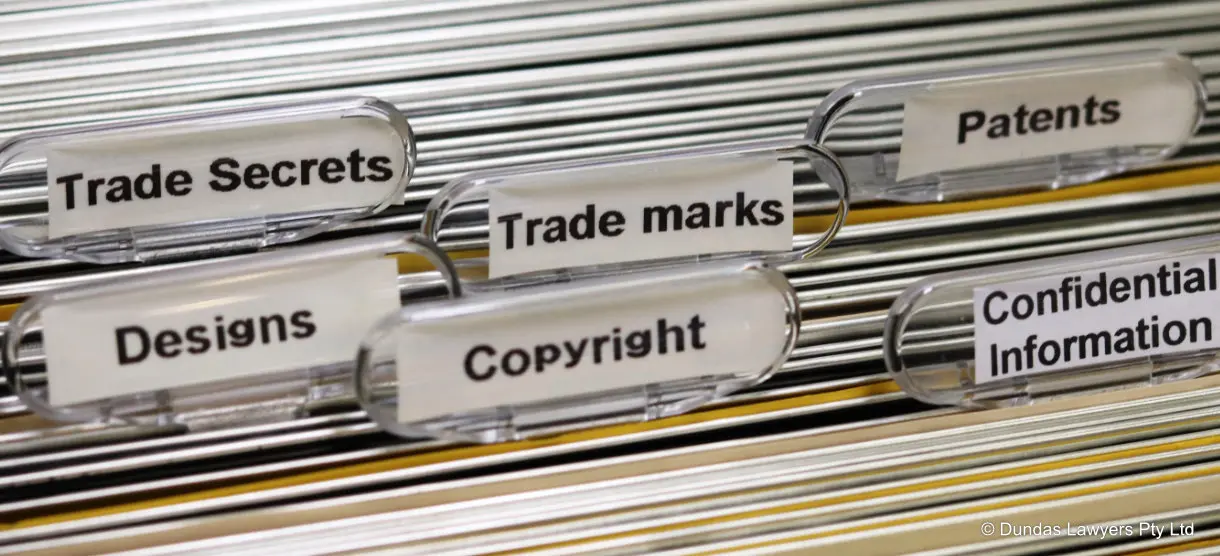
At Dundas Lawyers®, we understand that defending or enforcing of your business’s rights in copyright, trademarks, patents and confidential information can be critical for business success. Infringement and intellectual property theft is on the rise in the modern digital landscape. For many businesses, intellectual property protection involves more than just an idea or a concept, it is essential to protects genuine business assets. Dundas Lawyers has experience identifying, enforcing and defending intellectual property rights and has acted for businesses inside and outside of the courtroom.
Why choose Dundas Lawyers®?
Having exerted Blood Sweat and Years® since April 2010 we are the team you want on your side for the long term to act as the ‘bodyguard’ for your IP rich business. Some of the reasons clients choose Dundas Lawyers® include:
- our Uncommon business acumen;
- our Uncommon expertise in transactional, compliance and litigious matters;
- our Uncommon expertise in dealing with IP rich businesses;
- our Uncommon customer focus;
- the fact that we don’t just know law, we know business!
- how we leverage our Uncommon Nous® to provide client solutions.
Considering getting a lawyer to advise your business?
For a confidential, no obligation initial telephone call to find out how we can help your IP rich business gain an uncommon advantage, please phone our team on either 1300 386 529 or 07 3221 0013.

Malcolm Burrows B.Bus.,MBA.,LL.B.,LL.M.,MQLS.
Legal Practice Director
T: +61 7 3221 0013 (preferred)
M: +61 419 726 535
E: mburrows@dundaslawyers.com.au

Legislation
Recent insights for IP Rich Businesses
-

Understanding contributory liability in patent infringement
In Australia, the Patent Act 1990 (Cth) provides protection for inventors by preventing others from using, making, or selling patented inventions without permission. The Act also extends liability to parties that are not directly infringing patents but may contribute to or enable patent infringement by supplying a product.
-
Cross-border licensing – Maxim Media Inc. v Nuclear Enterprises
The Federal Court decision in Maxim Media Inc. v Nuclear Enterprises Pty Ltd [2024] FCA 1443 involved an interlocutory application seeking injunctive relief by Maxim Media Inc. and Maxim Inc. (together, Maxim) (Applicants) for alleged breaches of sections 18 and 29 of the Competition and Consumer Act 2010 (Cth), passing off and infringement of a…
-
Use of confidential information – the springboard injunction
This article examines the UK decision of Forse & ors v Secarma Ltd & ors [2019] EWCA Civ 215, which discussed the legal concept of a springboard injunction, and its implications in Australia. The Court must consider similar principles to determine if an injunction should be granted.
-
Do meta tags amount to trade mark infringement?
Find out how the case of Accor Australia & New Zealand Hospitality Pty Ltd v Liv Pty Ltd [2015] FCA 554 highlights the potential risk of trademark infringements to businesses. Read more to discover the case background, takeaways, and tips to protect your business.
-
IP contracts subject to restrictive trade practice provisions
Learn how the repeal of Section 51(3) of the Competition and Consumer Act 2010 (Cth) (CCA) affects businesses licensing or assigning intellectual property (IP) rights and the penalties associated with a breach with this comprehensive guide.
-
Confusing marks – Sensis v Senses
Sensis Pty Ltd v Senses Direct Mail and Fulfillment Pty Ltd [2019] FCA 719: Court ruled SENSES marks deceptively similar to SENSIS marks, highlighting importance of engaging intellectual property lawyers when building a brand. Marks can be infringing if spelling is only slightly different, if it resembles another and likely to deceive and cause confusion.



Recent Federal Court decisions regarding IP rich businesses
-
Universal City Studios LLC v Telstra Limited (No 2) [2025] FCA 1485
COPYRIGHT – application for orders disabling access to new means of access to certain target online locations (Additional Urgent Access Means) – where site blocking and ancillary orders previously made with respect to target online locations under s 115A of the Copyright Act 1968 (Cth) – where target online locations subsequently made available through different…
-
Southern Cross Industrial Group PL v Mickala Mining Maintenance PL (Liability Trial) [2025] FCA 1363
PATENTS – construction – invalidity – whether claims 1 and 4 of innovation patent lack novelty – factual dispute concerning public availability – whether lack of innovative step – whether sole director of company authorised infringement of claims – whether sole director is liable as a joint tortfeasor – where claims 1 and 4 found…
-
The NOCO Company v Brown and Watson International Pty Ltd [2025] FCA 887
The NOCO Company v Brown and Watson International Pty Ltd [2025] FCA 887
