
The Australian Cyber Law Map (Map) is a collaborative guide intended to help legal practitioners navigate through the detailed and complicated legal landscape of Australian cyber-related legislation and case law. Within the Map, the ever-evolving area of cyber law has existing principles and new development categorises. The Map and the categories it focuses on can be easily understood via the following visualisation.
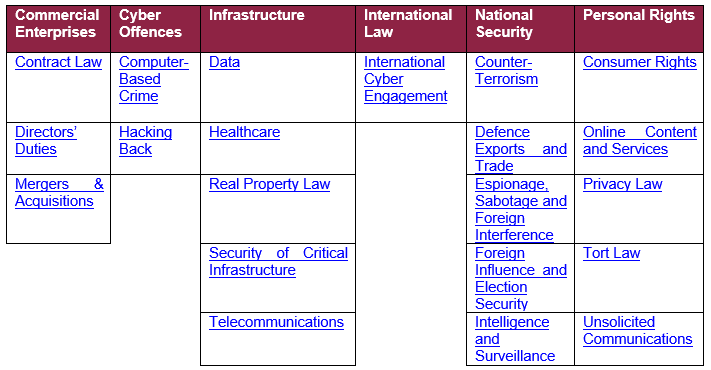
This article discusses the Map and its key benefits and applications.
The Map’s benefits
The Map provides some clarity, in an area of law that is developing at such a substantial rate that it is difficult for practitioners to keep abreast of changes. Added to this challenge is the lack of certainty in Australia’s cyber laws. That is to say, new and rapid technological developments may demand responsive legislative implementations. There is no dedicated instrument intended solely to respond to the, often positively, disruptive impact that innovative technologies have in various areas of law. For example, there is no legislation governing the interface between cyber law and the law surrounding commercial enterprises.
Notwithstanding that such interface will often result in safer, more secure commercial dealings, for example, smart contracts protected through blockchain technology, the interface, and other cyber developments, need to be regulated to ensure fairness and deter opportunistic misdealing.
Applications
The Map details how, in the context of an increasingly digital commercial scene, common cyber issues or disputes may give rise to legal remedies. The Map considers how existing legal principles surrounding contracts, directors’ duties and mergers and acquisitions interact with cyber law. For example, the Map discusses established common law principle, the doctrine of frustration,[1] to modern circumstances. The Map states that negligence may prevent a party from relying on frustration in response to a cyber risk, such as where careless mistakes are involved.[2]
On a larger scale, the project is contributing to societal welfare by bringing to the forefront of the legal profession expert analysis of how cyber-law may interact with and protect critical infrastructure. The Map considers the Australian Government’s Critical Infrastructure Resilience Strategy (Strategy) in order to provide analysis which may be assistive in policy decisions. The Strategy provides the following definition for critical infrastructure:
“…those physical facilities, supply chains, information technologies and communication networks, which if destroyed, degraded or rendered unavailable for an extended period, would significantly impact on the social or economic wellbeing of the nation, or affect Australia’s ability to conduct national defence and ensure national security.”
One would need to look no further than the recent cyber-attack on the Colonial Pipeline to understand the importance of legislative and policy protections being in place to prevent or deter such attacks. Proper legislative safeguards surrounding cyber-security will protect critical infrastructure’s continued operation in the face of all hazards. The Map is assistive in bringing about this end by being a mechanism for the recognition and communication of legal analysis performed by leading experts in the field of cyber law.
Takeaways
The Map aims to guide the legal profession across areas of cyber law in the country and its application to certain areas of law. These areas are: Commercial Enterprises, Cyber Offences, Infrastructure, International Law, National Security and Personal Rights. The Map strives to provide clarity amongst the challenges of practicing in the ever-changing legal landscape of Australian cyber law. What has been evidenced so far is the Map providing frameworks for certain issues such as when negligence can impact on the doctrine of frustration in contract law matters.
Further information about Australian cyber law
If you need advice on the evolving area of Australian cyber law, contact us for a confidential and obligation-free discussion:

Malcolm Burrows B.Bus.,MBA.,LL.B.,LL.M.,MQLS.
Legal Practice Director
T: +61 7 3221 0013 (preferred)
M: +61 419 726 535
E: mburrows@dundaslawyers.com.au

Disclaimer
This article contains general commentary only. You should not rely on the commentary as legal advice. Specific legal advice should be obtained to ascertain how the law applies to your particular circumstances.
Related insights about Australian cyber law
-

Are email trackers admissible as evidence?
The Evidence Act 1995 (Cth) is silent, but the Court considers email trackers and read receipts as evidence in civil and intellectual property litigation. As seen in Jaffari v Grabowski [2013] NSWCA 114, sender’s receipt of confirmation of email relay is a matter for the recipient.
-
Is AI recognized as an inventor under the Patents Act 1990?
The ruling of Thaler v Commissioner of Patents [2021] FCA 879 has opened the door for artificial intelligence-created inventions to be eligible for patent protection. Learn more about the implications of this groundbreaking decision.
-
The Australian Cyber Law Map – overview
The Australian Cyber Law Map provides clarity on ever-changing legal landscape, covering commercial enterprises, cyber offences, infrastructure, international law, national security and personal rights. A source for understanding laws and providing safety/security in the digital age.
-
Explaining Australia’s Media Bargaining Code
The News Media Bargaining Code (NMBC) is quickly moving through Parliament and looks likely to become law. It requires digital platforms, such as Facebook and Google, to negotiate remuneration with News Companies for providing their media services. Non-compliance could result in hefty civil penalties.
-
Kogan fined $310k for Spam Act breaches
Kogan Australia Pty Ltd has been issued a hefty penalty and an enforceable undertaking for not complying with the Spam Act 2003 (Cth). Find out what this means for your business and what the consequences are for failing to comply.
-
Warning – Facebook trolls ordered to pay $150k damages
An online defamation case has resulted in two trolls being ordered to pay a hefty sum in damages. Learn more about the case and the potential consequences of making false claims online.
-
My client poached my software developers – what can I do?
This article examines how professional service businesses can protect their investment in employees from clients poaching them. It looks at potential clauses such as client agreements, non-solicitation of employees, restraints of trade, confidential information, copyright and more.
-
Emojis used online can be defamatory – watch out!
This Australian Court case is the first to consider whether emojis can be defamatory. Find out what the Court concluded about this novel legal question.
-
Patent granted for software tracking user actions
A decision by Australian Patent Office provides insight into patentable subject matter for computer-implemented inventions. Case of Facebook, Inc. [2020] APO 19 is a successful example of technical improvement in computer-implemented method, resulting in patentability even with generic computer implementation.