
The Australian Cyber Law Map (Map) is a collaborative guide intended to help legal practitioners navigate through the detailed and complicated legal landscape of Australian cyber-related legislation and case law. Within the Map, the ever-evolving area of cyber law has existing principles and new development categorises. The Map and the categories it focuses on can be easily understood via the following visualisation.
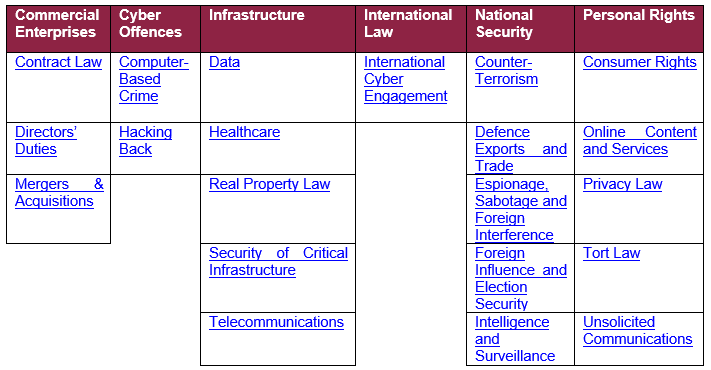
This article discusses the Map and its key benefits and applications.
The Map’s benefits
The Map provides some clarity, in an area of law that is developing at such a substantial rate that it is difficult for practitioners to keep abreast of changes. Added to this challenge is the lack of certainty in Australia’s cyber laws. That is to say, new and rapid technological developments may demand responsive legislative implementations. There is no dedicated instrument intended solely to respond to the, often positively, disruptive impact that innovative technologies have in various areas of law. For example, there is no legislation governing the interface between cyber law and the law surrounding commercial enterprises.
Notwithstanding that such interface will often result in safer, more secure commercial dealings, for example, smart contracts protected through blockchain technology, the interface, and other cyber developments, need to be regulated to ensure fairness and deter opportunistic misdealing.
Applications
The Map details how, in the context of an increasingly digital commercial scene, common cyber issues or disputes may give rise to legal remedies. The Map considers how existing legal principles surrounding contracts, directors’ duties and mergers and acquisitions interact with cyber law. For example, the Map discusses established common law principle, the doctrine of frustration,[1] to modern circumstances. The Map states that negligence may prevent a party from relying on frustration in response to a cyber risk, such as where careless mistakes are involved.[2]
On a larger scale, the project is contributing to societal welfare by bringing to the forefront of the legal profession expert analysis of how cyber-law may interact with and protect critical infrastructure. The Map considers the Australian Government’s Critical Infrastructure Resilience Strategy (Strategy) in order to provide analysis which may be assistive in policy decisions. The Strategy provides the following definition for critical infrastructure:
“…those physical facilities, supply chains, information technologies and communication networks, which if destroyed, degraded or rendered unavailable for an extended period, would significantly impact on the social or economic wellbeing of the nation, or affect Australia’s ability to conduct national defence and ensure national security.”
One would need to look no further than the recent cyber-attack on the Colonial Pipeline to understand the importance of legislative and policy protections being in place to prevent or deter such attacks. Proper legislative safeguards surrounding cyber-security will protect critical infrastructure’s continued operation in the face of all hazards. The Map is assistive in bringing about this end by being a mechanism for the recognition and communication of legal analysis performed by leading experts in the field of cyber law.
Takeaways
The Map aims to guide the legal profession across areas of cyber law in the country and its application to certain areas of law. These areas are: Commercial Enterprises, Cyber Offences, Infrastructure, International Law, National Security and Personal Rights. The Map strives to provide clarity amongst the challenges of practicing in the ever-changing legal landscape of Australian cyber law. What has been evidenced so far is the Map providing frameworks for certain issues such as when negligence can impact on the doctrine of frustration in contract law matters.
Further information about Australian cyber law
If you need advice on the evolving area of Australian cyber law, contact us for a confidential and obligation-free discussion:

Malcolm Burrows B.Bus.,MBA.,LL.B.,LL.M.,MQLS.
Legal Practice Director
T: +61 7 3221 0013 (preferred)
M: +61 419 726 535
E: mburrows@dundaslawyers.com.au

Disclaimer
This article contains general commentary only. You should not rely on the commentary as legal advice. Specific legal advice should be obtained to ascertain how the law applies to your particular circumstances.
Related insights about Australian cyber law
-

Evidence from the Wayback Machine accepted
Australian Courts are increasingly considering the use of evidence from the Wayback Machine, but questions remain as to whether they will accept such reports in practice and what will be allowed?
-
$750k awarded for fake online reviews
The Supreme Court of South Australia awarded $A750,000 in damages to a lawyer in the case of Cheng v Lok [2020] SASC 14, demonstrating the serious consequences of posting fake reviews online. Find out more about the implications of this case and alternative legal actions for companies that receive negative reviews.
-
Adaptations and computer code – copyright issues
An adaption in copyright is the exclusive right of the owner of the work in question. Section 10 of the Copyright Act 1968 (Cth) (Act) defines adaption as it relates to literary works in dramatic and non-dramatic forms, in a computer program and in relation to a musical work. The rights that apply to adaptions…
-
Australian court orders Google to unmask reviewer
The case of Kabbabe v Google LLC [2020] FCA 126 has major implications for businesses and online reviewers alike. Learn more about the Court’s decision and what it means for anonymous online reviews by reading the full article.
-
Computer code libraries and copyright ownership
The Australian case of Redrock Holdings Pty Ltd and Hotline Communications Ltd v Hinkley [2001] VSC 91 has shed light on how the ownership of copyright in code libraries is determined. Learn more about the dispute and its implications for copyright ownership in this blog post.
-
e-Signatures – legally binding on companies?
E-signatures are becoming increasingly popular, but are they legally binding? Find out in this article, which examines the Adelaide Bank case and reveals the limitations of e-signatures when it comes to executing a deed. Click through to learn more.
-
New safety standards proposed for online platforms
The Australian Government has proposed an Online Safety Act that could significantly change the way businesses manage user-generated content online. Find out how this proposed Act could affect your business and how you can prepare for it.
-
Has my software been copied? – legal test explained
This article examines the legal test for a “substantial reproduction” of computer code, as established by the High Court in Data Access Corporation v Powerflex Services Pty Ltd [1999] HCA 49 and further discussed in subsequent cases. The Court will consider the essential features of the work to determine if there has been a substantial…
-
A bet or a game? The Lottoland decision
The Supreme Court of New South Wales has ruled in favour of Lottoland Australia Pty Ltd, affirming that its disputed products fall under the exception of an Excluded Wagering Service as defined by the Interactive Gambling Act 2001 (Cth), clarifying the distinction between ‘bets’ and ‘games’.