
The Australian Cyber Law Map (Map) is a collaborative guide intended to help legal practitioners navigate through the detailed and complicated legal landscape of Australian cyber-related legislation and case law. Within the Map, the ever-evolving area of cyber law has existing principles and new development categorises. The Map and the categories it focuses on can be easily understood via the following visualisation.
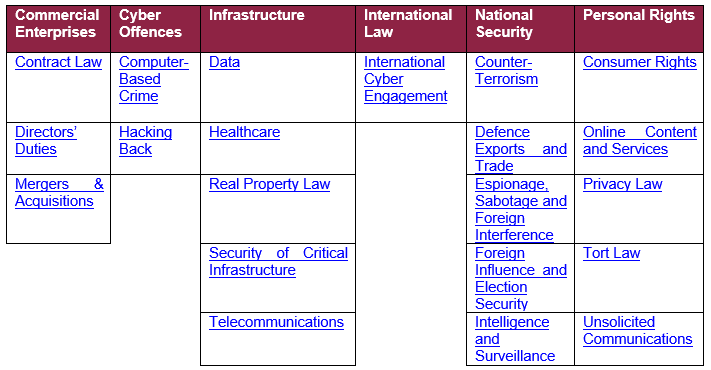
This article discusses the Map and its key benefits and applications.
The Map’s benefits
The Map provides some clarity, in an area of law that is developing at such a substantial rate that it is difficult for practitioners to keep abreast of changes. Added to this challenge is the lack of certainty in Australia’s cyber laws. That is to say, new and rapid technological developments may demand responsive legislative implementations. There is no dedicated instrument intended solely to respond to the, often positively, disruptive impact that innovative technologies have in various areas of law. For example, there is no legislation governing the interface between cyber law and the law surrounding commercial enterprises.
Notwithstanding that such interface will often result in safer, more secure commercial dealings, for example, smart contracts protected through blockchain technology, the interface, and other cyber developments, need to be regulated to ensure fairness and deter opportunistic misdealing.
Applications
The Map details how, in the context of an increasingly digital commercial scene, common cyber issues or disputes may give rise to legal remedies. The Map considers how existing legal principles surrounding contracts, directors’ duties and mergers and acquisitions interact with cyber law. For example, the Map discusses established common law principle, the doctrine of frustration,[1] to modern circumstances. The Map states that negligence may prevent a party from relying on frustration in response to a cyber risk, such as where careless mistakes are involved.[2]
On a larger scale, the project is contributing to societal welfare by bringing to the forefront of the legal profession expert analysis of how cyber-law may interact with and protect critical infrastructure. The Map considers the Australian Government’s Critical Infrastructure Resilience Strategy (Strategy) in order to provide analysis which may be assistive in policy decisions. The Strategy provides the following definition for critical infrastructure:
“…those physical facilities, supply chains, information technologies and communication networks, which if destroyed, degraded or rendered unavailable for an extended period, would significantly impact on the social or economic wellbeing of the nation, or affect Australia’s ability to conduct national defence and ensure national security.”
One would need to look no further than the recent cyber-attack on the Colonial Pipeline to understand the importance of legislative and policy protections being in place to prevent or deter such attacks. Proper legislative safeguards surrounding cyber-security will protect critical infrastructure’s continued operation in the face of all hazards. The Map is assistive in bringing about this end by being a mechanism for the recognition and communication of legal analysis performed by leading experts in the field of cyber law.
Takeaways
The Map aims to guide the legal profession across areas of cyber law in the country and its application to certain areas of law. These areas are: Commercial Enterprises, Cyber Offences, Infrastructure, International Law, National Security and Personal Rights. The Map strives to provide clarity amongst the challenges of practicing in the ever-changing legal landscape of Australian cyber law. What has been evidenced so far is the Map providing frameworks for certain issues such as when negligence can impact on the doctrine of frustration in contract law matters.
Further information about Australian cyber law
If you need advice on the evolving area of Australian cyber law, contact us for a confidential and obligation-free discussion:

Malcolm Burrows B.Bus.,MBA.,LL.B.,LL.M.,MQLS.
Legal Practice Director
T: +61 7 3221 0013 (preferred)
M: +61 419 726 535
E: mburrows@dundaslawyers.com.au

Disclaimer
This article contains general commentary only. You should not rely on the commentary as legal advice. Specific legal advice should be obtained to ascertain how the law applies to your particular circumstances.
Related insights about Australian cyber law
-

Are software developers responsible for defects in their software?
Software developers in Australia may face legal liability in negligence and under the Australian Consumer Law. This article examines what is required for negligence in the context of relevant case law.
-
Legal challenges arising from data loss
Organisations must protect confidential data from external and internal threats. Learn steps to secure data, potential data breach implications, and how a data breach notification bill may require affected entities to notify consumers.
-
Data Breach Bill 2016 – key data security considerations
The Privacy Amendment (Notifiable Data Breaches) Bill 2016 has been passed, making notification of data breaches mandatory from 23 February 2018. Find out how this could affect you and what measures you can take to protect your data.
-
What are Software Development Agreements?
Having a Software Development Agreement (SDA) is essential for any successful software development project. Learn more about the key clauses involved and how to avoid potential issues.
-
Legal risks in the in-app purchase model
Software developers and publishers are offering users the chance to make In-App Purchases within their software, but there are legal risks involved. Learn how to protect yourself and your business by understanding the requirements of distribution platforms and Australian consumer law.
-
Letting go of employees threatening to go to the media
When employees leak confidential information or threaten to go to the media, employers can face serious consequences. Find out what the Fair Work Commission says about this issue and what options employers have to protect themselves.
-
App developers – take care with Apple Developer License
Creating apps for Apple devices requires adherence to Apple’s Developer Agreement, Program Licence Agreement, and App Store Review Guidelines. Learn about your rights and obligations when it comes to agreeing to Apple’s terms and conditions, and the consequences of ignoring them.
-
Data security – the increasing burden
The consequences for an Australian business victim for a breach of cyber security are forecast to exponentially increase. In February 2015 the Parliamentary Joint Committee on Intelligence and Security (Committee) recommended the introduction of mandatory data breach notification scheme (Scheme) by the end of 2015.[1] Whilst the details of the incoming Scheme are currently scant,…
-
What exactly is an advertising sign-off?
Injunctions are Court orders that can restrain almost any conduct. Prohibitory, Mandatory, and Ex Parte injunctions can be sought if serious question to be tried, urgency, damages would not suffice, and the balance of convenience favours the applicant.