
The Australian Cyber Law Map (Map) is a collaborative guide intended to help legal practitioners navigate through the detailed and complicated legal landscape of Australian cyber-related legislation and case law. Within the Map, the ever-evolving area of cyber law has existing principles and new development categorises. The Map and the categories it focuses on can be easily understood via the following visualisation.
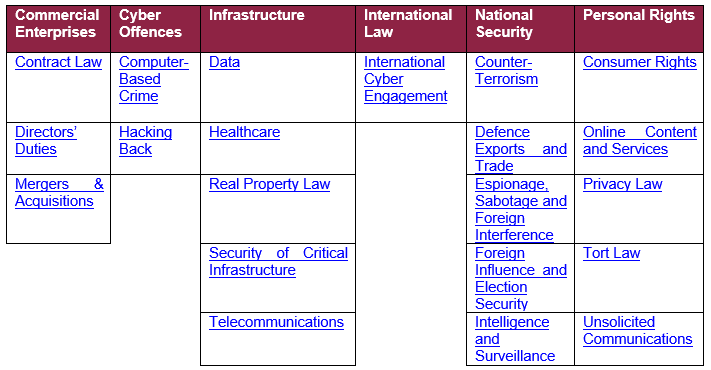
This article discusses the Map and its key benefits and applications.
The Map’s benefits
The Map provides some clarity, in an area of law that is developing at such a substantial rate that it is difficult for practitioners to keep abreast of changes. Added to this challenge is the lack of certainty in Australia’s cyber laws. That is to say, new and rapid technological developments may demand responsive legislative implementations. There is no dedicated instrument intended solely to respond to the, often positively, disruptive impact that innovative technologies have in various areas of law. For example, there is no legislation governing the interface between cyber law and the law surrounding commercial enterprises.
Notwithstanding that such interface will often result in safer, more secure commercial dealings, for example, smart contracts protected through blockchain technology, the interface, and other cyber developments, need to be regulated to ensure fairness and deter opportunistic misdealing.
Applications
The Map details how, in the context of an increasingly digital commercial scene, common cyber issues or disputes may give rise to legal remedies. The Map considers how existing legal principles surrounding contracts, directors’ duties and mergers and acquisitions interact with cyber law. For example, the Map discusses established common law principle, the doctrine of frustration,[1] to modern circumstances. The Map states that negligence may prevent a party from relying on frustration in response to a cyber risk, such as where careless mistakes are involved.[2]
On a larger scale, the project is contributing to societal welfare by bringing to the forefront of the legal profession expert analysis of how cyber-law may interact with and protect critical infrastructure. The Map considers the Australian Government’s Critical Infrastructure Resilience Strategy (Strategy) in order to provide analysis which may be assistive in policy decisions. The Strategy provides the following definition for critical infrastructure:
“…those physical facilities, supply chains, information technologies and communication networks, which if destroyed, degraded or rendered unavailable for an extended period, would significantly impact on the social or economic wellbeing of the nation, or affect Australia’s ability to conduct national defence and ensure national security.”
One would need to look no further than the recent cyber-attack on the Colonial Pipeline to understand the importance of legislative and policy protections being in place to prevent or deter such attacks. Proper legislative safeguards surrounding cyber-security will protect critical infrastructure’s continued operation in the face of all hazards. The Map is assistive in bringing about this end by being a mechanism for the recognition and communication of legal analysis performed by leading experts in the field of cyber law.
Takeaways
The Map aims to guide the legal profession across areas of cyber law in the country and its application to certain areas of law. These areas are: Commercial Enterprises, Cyber Offences, Infrastructure, International Law, National Security and Personal Rights. The Map strives to provide clarity amongst the challenges of practicing in the ever-changing legal landscape of Australian cyber law. What has been evidenced so far is the Map providing frameworks for certain issues such as when negligence can impact on the doctrine of frustration in contract law matters.
Further information about Australian cyber law
If you need advice on the evolving area of Australian cyber law, contact us for a confidential and obligation-free discussion:

Malcolm Burrows B.Bus.,MBA.,LL.B.,LL.M.,MQLS.
Legal Practice Director
T: +61 7 3221 0013 (preferred)
M: +61 419 726 535
E: mburrows@dundaslawyers.com.au

Disclaimer
This article contains general commentary only. You should not rely on the commentary as legal advice. Specific legal advice should be obtained to ascertain how the law applies to your particular circumstances.
Related insights about Australian cyber law
-

Comparing software developers by methodology
Software development requires careful consideration: choice of onshore/offshore devs, methodology (Agile/Waterfall), type of requirement document, and the cost. Learn the differences to make an informed decision before committing to a development for your project.
-
Is using a trade mark in AdWords considered infringement?
A Court concluded that a company had infringed a trade mark using Google AdWords in Veda Advantage Limited v Malouf Group Enterprises Pty Limited [2016] FCA 255. Click through to learn more about the dispute, and the learning points and takeaways.
-
Copyright infringement for computer code
Computer code is automatically protected by copyright. Unauthorised reproduction of it may constitute an infringement, as illustrated by two federal cases. To understand copyright infringement with respect to computer code, read “Who owns the code?”
-
Who holds ownership of the code?
Understand who owns the computer code used in software development projects. Consider employee or contractor engagement, joint ownership, and assignment of copyright to ensure your project is protected.
-
ASIC issues statement on Initial Coin Offering
The Australian Securities and Investments Commission releases an Information Sheet to help companies with Initial Coin Offerings (ICOs), but Commissioner John Price warns of the speculative and unregulated nature of investing in them.
-
Do you need to disclose a database?
This article looks at the disclosure requirements for civil litigation in Queensland, and whether computer databases are considered ‘documents’ in this context. Get an overview of the relevant legal precedent and definitions, and discover the key points to consider.
-
What exactly is an Initial Coin Offering?
With the rise of cryptocurrencies (think Bitcoin and Ethereum), start-up businesses have engaged in a new method of sourcing funding from would-be investors – Initial Coin Offerings (ICOs). ICOs are becoming an increasingly popular method for new businesses to raise money in a short period of time with minimal effort. As ICOs are a new…
-
Software as a service (SaaS) contracts
Drafting a SaaS (Software-as-a-Service) contract requires careful legal consideration. This article covers the business model, Australian Consumer Law (ACL), jurisdiction and choice of law, third party access, data, user-generated content, intellectual property (IP) ownership and major clauses. Learn how to ensure an effective SaaS contract is in place.
-
Software licences classified as “goods” under the ACL
This Federal Court case highlights the risks of supplying goods and services to Australian consumers. Companies should be aware of their legal obligations and seek advice to ensure their contractual terms comply with Australian Consumer Law. Find out more about the case and its implications.